

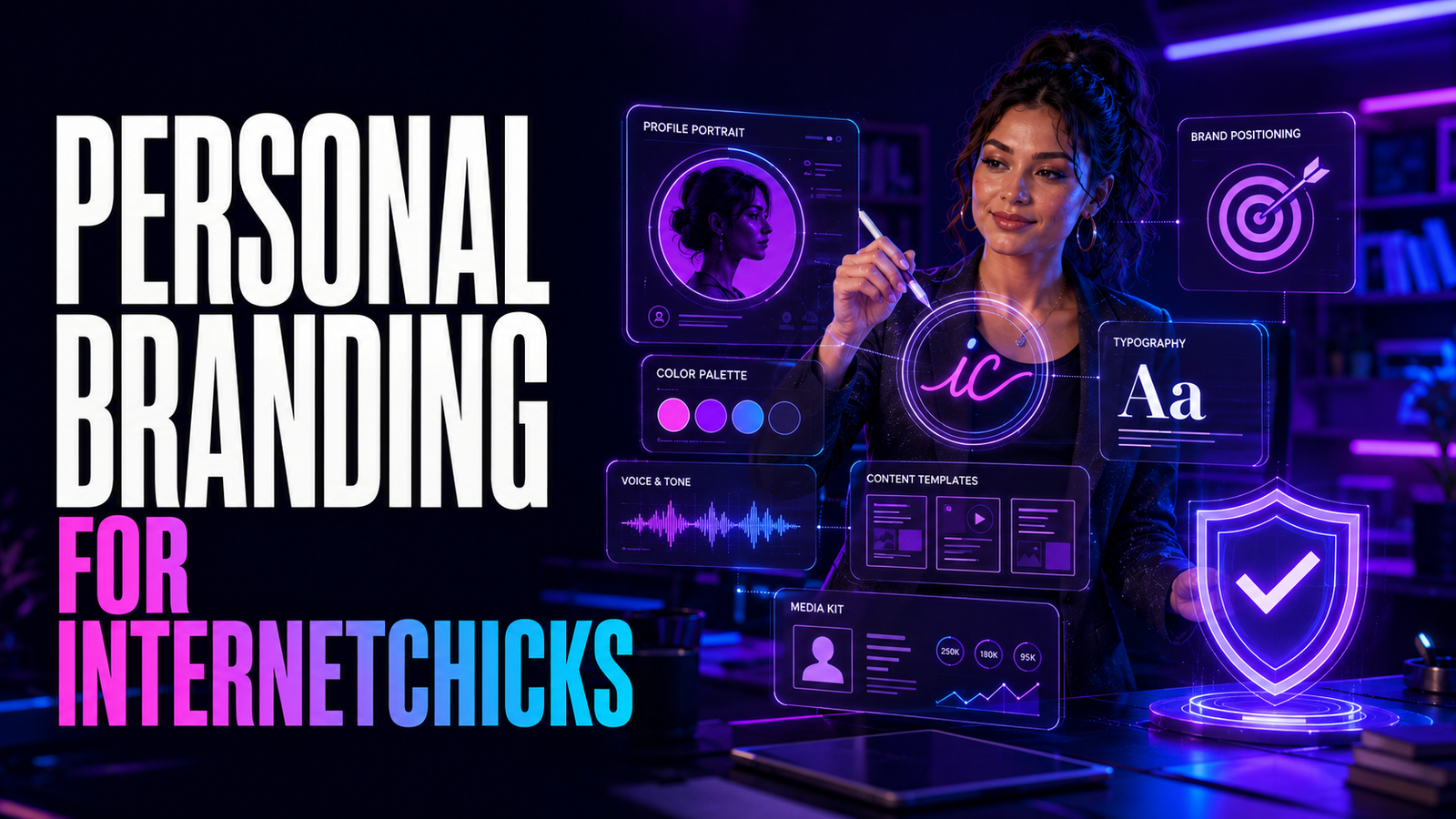
A personal brand is what people expect before they open the next post.
They may expect a sharp explanation, a calming visual style, a blunt review, a thoughtful story, a useful tutorial, or a joke that only this community would make. That expectation is built through repeated choices: what the creator discusses, how she sees it, what she refuses to promote, how the work looks, and how the audience feels after spending time with it.
That is why personal branding for Internetchicks is larger than a logo. A polished color palette can make a profile attractive, but it cannot explain why the creator matters. The real brand lives underneath the decoration, in positioning, voice, proof, values, boundaries, and a recognizable way of delivering value.
This guide shows how to build that system without turning a real person into a corporate mascot. If you are starting from the beginning, the broader guide on how to become an Internetchick explains niches, platforms, content pillars, and early publishing. Here, the focus is the identity connecting all of those pieces.
What Is a Personal Brand?
A personal brand is the impression people form from a creator’s public work. Some parts are designed deliberately; others emerge through behavior.
It includes:
- The subjects the creator repeatedly covers
- The audience she appears to understand
- The perspective or standard behind her opinions
- The tone and language she uses
- The quality and style of the presentation
- The way she handles mistakes, criticism, and sponsorships
- The products, people, and causes she chooses to associate with
- The boundaries between her public identity and private life
Visuals help people recognize the brand. Behavior helps them believe it.
A creator who describes herself as honest but hides sponsorships has a trust problem, not a typography problem. A profile that promises beginner-friendly advice but speaks as if every viewer should already know the basics has a positioning problem. Branding makes these gaps easier to notice.
The Five Layers of a Creator Brand
Think of the brand as five connected layers:
| Brand layer | Question it answers | Practical output |
|---|---|---|
| Positioning | Why this creator, for this audience, on this subject? | Niche, audience, promise, point of difference |
| Personality | What does it feel like to hear from her? | Voice, tone, humor, energy, boundaries |
| Presentation | How is the brand recognized visually? | Color, typography, imagery, layouts, profile assets |
| Proof | Why should the audience trust the promise? | Original work, experience, sources, results, testimonials |
| Practice | Does behavior support the identity over time? | Consistent content, disclosure, community conduct, brand choices |
Weak personal brands often overbuild the presentation layer because it is the easiest part to see. Strong ones keep all five aligned.
Start With Positioning, Not a Mood Board
Positioning gives the brand a useful place in the audience’s mind.
“Beauty creator” identifies a category. “Affordable makeup tested on sensitive skin, with no miracle claims” identifies an audience, a practical standard, and a point of view. “Gaming streamer” is broad. “Story-focused indie games for people who want relaxed evening streams” already suggests content, community tone, and platform fit.
Write down four elements:
- Audience: Who is the work most useful or entertaining for?
- Territory: Which subject or world does the creator consistently explore?
- Value: What does the audience receive—clarity, confidence, entertainment, discovery, belonging, or a result?
- Perspective: What makes the creator’s approach recognizably hers?
Then combine them into one working sentence:
I help [specific audience] get [useful outcome] through [distinct approach].
This sentence is not necessarily a public slogan. It is an internal filter. It helps decide whether a collaboration, post, product, or platform strengthens the brand or scatters it.
Create a Brand Promise People Can Understand
A brand promise is the repeated value behind the content.
It does not need to sound dramatic. A recipe creator might promise weeknight meals that use ordinary supermarket ingredients. A career creator may promise practical advice without pretending work is a perfect meritocracy. A fashion creator could promise outfits that are stylish, rewearable, and honest about cost.
The promise should be:
- Clear enough to explain in one sentence
- Broad enough to support many posts
- Specific enough to attract the right audience
- Honest about the creator’s actual knowledge and resources
- Sustainable as interests and skills develop
Do not promise an outcome the creator cannot control. “I will make you successful” is inflated. “I break down the client systems that helped me run a freelance design business” is credible and specific.
The strongest promise often sounds less impressive than marketing language and more useful to a real person.
Choose a Point of View, Not Just a Topic
Topics are easy to copy. A point of view is harder.
Two travel creators may visit the same city. One focuses on accessibility, another on architecture, another on solo safety, and another on food within a strict budget. The destination is shared; the way of seeing it creates distinction.
Ask:
- What do I pay attention to that others often overlook?
- Which common advice do I think needs more nuance?
- What standard do I use when reviewing something?
- Which experiences shape the way I explain this topic?
- What will I not pretend to know?
Having a point of view does not mean forcing controversy. It means making judgment visible. Audiences remember creators who help them see familiar subjects differently.
Build a Brand Voice That Sounds Like a Person
Brand voice is the consistent character of the communication. Tone changes with the moment.
A creator may have a warm, direct voice while using a more serious tone for safety information and a playful tone for behind-the-scenes posts. The identity remains recognizable even as the emotional setting changes.
Choose three or four voice qualities that describe how the work should feel. Make them specific enough to guide writing:
| Voice quality | What it sounds like | What to avoid |
| Warm | Welcoming, human, generous with context | Forced intimacy or calling every stranger “bestie” |
| Direct | Clear conclusions and useful next steps | Rudeness presented as honesty |
| Curious | Open questions, experiments, visible learning | Pretending every uncertainty is expertise |
| Playful | Wit, timing, familiar community language | Jokes that weaken serious advice or target vulnerable people |
| Calm | Measured pace, uncluttered explanation | Sounding distant or emotionally flat |
| Analytical | Evidence, comparisons, transparent standards | Jargon used to impress rather than explain |
Create a short list of phrases the brand naturally uses and phrases that feel wrong. Decide whether captions use short sentences or detailed storytelling, whether humor is dry or expressive, and how the creator introduces uncertainty, corrections, or sponsored work.
Do not write every post from a rigid script. The guide should preserve the person, not replace her.
Let Personality Support the Value
Personality makes useful content memorable. It should not force the creator to perform a character she cannot maintain.
Some creators are energetic on camera. Others build connection through careful explanations, dry humor, visual taste, patient livestreams, or thoughtful writing. None is automatically more authentic.
Show personality through choices:
- The examples selected
- The stories used to explain an idea
- The questions asked of the audience
- The standards behind a review
- The way mistakes are handled
- The rhythm of editing or writing
- The recurring details the community recognizes
Avoid treating oversharing as the price of relatability. A creator can be emotionally honest while keeping home addresses, family conflict, relationships, health details, and real-time locations private. The online safety for Internetchicks guide explains how to create those boundaries early.
Design a Simple Visual Identity System
Visual identity helps the audience recognize the creator before reading the username. The goal is consistency, not visual sameness.
A practical starter system includes:
- One primary color and two or three supporting colors
- One headline type style and one readable body style
- A consistent approach to photography or illustration
- Two or three reusable layouts for covers, carousels, thumbnails, or Pins
- A simple rule for icons, borders, shadows, and graphic accents
- Clear spacing and contrast standards
Choose colors and fonts because they fit the voice and remain readable, not because they appear in a trend forecast. A bold entertainment account may use high contrast and energetic type. A quiet education brand may use restrained layouts and generous space. A premium look can still feel human; a playful look can still feel organized.
Test every design on a small phone screen. If the title only works when viewed full-size, it is not doing its job as a thumbnail. Check color contrast, caption size, and whether meaning depends entirely on color.
Visual consistency should shorten recognition. It should never make every post look like the same template with different words.
Choose a Name and Handle That Can Travel
A creator name may be a real name, nickname, pseudonym, business name, or a combination. The best choice depends on privacy, future plans, and what the audience can remember.
Consider:
- Is it easy to spell after hearing it once?
- Can someone search for it without confusing results?
- Does it still fit if the content grows beyond one narrow format?
- Is a similar handle available on the most important channels?
- Does it resemble an established brand or creator too closely?
- Is the creator comfortable connecting it to her real identity?
Consistency across platforms is useful, but not worth choosing an unreadable string of numbers. A clean variation is better than a “perfect” handle nobody can remember.
Platform rules differ. TikTok’s profile setup guidance separates profile photos, nicknames, usernames, and connected links, while username changes have their own limits and effects. Check current platform guidance before changing an established handle.
Before committing to a business-facing name, search domains, major platforms, and relevant trademark databases in the countries where the creator expects to operate. A username being available does not automatically mean a commercial name is legally safe.
Make the Profile Explain Itself in Seconds
A strong creator profile does not require the visitor to decode a personal mission statement.
Use this structure:
- Identity: Name or recognizable creator label
- Value: What the person creates and for whom
- Proof or distinction: Relevant experience, result, format, or point of view
- Next step: Watch a series, join a list, visit a shop, book a service, or read a guide
For example:
Practical AI workflows for freelance designers. Weekly tool tests, honest limits, and client-ready systems. Start with the free workflow guide.
The bio is specific without trying to contain an entire life story.
Keep the profile image recognizable at small sizes. Use Highlights, pinned posts, channel sections, or playlists to help new visitors understand the work. Instagram’s official profile guidance encourages creators to keep the bio, profile picture, and Highlights current while using captions to express brand personality.
YouTube allows creators to organize a trailer, featured video, sections, profile image, banner, handle, description, and links through channel customization. Treat these elements as an introduction, not decoration.
Use Content to Prove the Brand
A brand statement makes a claim. Content provides evidence.
If the creator says she makes beginner-friendly tutorials, the explanations should actually respect beginners. If she promises honest reviews, the audience should see original testing, clear standards, and criticism even when a product is popular. If the brand centers sustainability, purchasing habits and partnerships should not constantly contradict that position.
Connect each content pillar to the brand promise:
- Education proves knowledge and clarity
- Process proves that the work is real
- Story explains why the perspective exists
- Opinion reveals standards and values
- Community shows how the creator treats people
- Offers show whether the business matches the promise
The content ideas for Internetchicks guide includes fifty adaptable formats. Use them to express a consistent identity, not merely fill a calendar.
Build Recognizable Series and Brand Assets
Repeated structures make the brand easier to remember.
A series might use a consistent name, opening question, visual frame, sound cue, or publishing rhythm. A newsletter may have familiar sections. A livestream can return to a community ritual. A review may always use the same three standards.
Useful brand assets include:
- A short creator introduction
- A clear profile photograph or mark
- Platform banners and cover templates
- Thumbnail and carousel systems
- A set of original photographs or footage
- A short and long biography
- A link page or website
- A media kit
- Email and proposal templates
- A source and disclosure policy
Not every asset needs to exist on day one. Build the pieces that solve a current problem, then add structure as the business grows.
YouTube’s official channel-branding tips emphasize consistent visuals, voice, values, and alignment across online and offline presentation. The platform also notes that branding can evolve when the creator’s values or message changes.
Turn Trust Into a Visible Brand Feature
Trust is not created by writing “authentic” in a bio. It develops when the audience can predict how the creator handles evidence, uncertainty, money, and mistakes.
Practical trust signals include:
- Separating personal experience from universal claims
- Linking important sources when the subject requires them
- Explaining how a product or service was tested
- Correcting errors without quietly rewriting history
- Disclosing sponsorships, gifts, affiliate relationships, and ownership
- Avoiding fake urgency or guaranteed outcomes
- Showing both strengths and limitations in reviews
- Protecting audience privacy and moderating responsibly
For content likely to affect U.S. consumers, the Federal Trade Commission says influencers should disclose material connections, including financial, employment, personal, family, free-product, and discounted-product relationships, in a way people can see and understand. The FTC’s Disclosures 101 guide also warns against hiding disclosures only on profile pages, after “more,” or inside a group of hashtags.
Other countries have their own advertising rules. Creators should check the requirements that apply to their location and audience.
Clear disclosure does not weaken a personal brand. It tells the audience that the creator expects the relationship to survive honesty.
Choose Partnerships That Make Sense in Public
A brand deal becomes part of the creator’s identity whether she intends it or not.
Before accepting, ask:
- Would I discuss this product without payment?
- Does it solve a real problem for my audience?
- Can I test it properly before making claims?
- Am I allowed to give an honest opinion?
- Does the company have behavior or policies that conflict with my stated values?
- Will the audience understand why this partnership belongs here?
- Are the usage rights, exclusivity, deadlines, revisions, and payment clear?
A high fee can still be expensive if the partnership damages trust or blocks better work through exclusivity. A smaller partnership can be valuable when the fit is obvious, the creative terms are fair, and the content remains useful.
The Internetchicks monetization guide explains sponsorships, affiliate income, products, memberships, services, and other business models in more detail.
Create a Media Kit That Matches the Brand
A creator media kit should help a relevant partner understand the opportunity quickly.
Include:
- A concise creator introduction
- The niche, audience, and brand promise
- Primary platforms and content formats
- Current audience and performance information with dates
- Audience location or demographics where useful and available
- Past partnerships or representative work
- Services or collaboration options
- Contact information
- A note that rates and usage terms depend on the project
Use accurate numbers. Distinguish followers, average views, reach, watch time, clicks, conversions, and other metrics rather than combining them into an impressive but unclear claim.
Design the kit in the same visual system as the public brand, but keep it easy to scan. The partner is evaluating fit, proof, and professionalism—not how many decorative elements fit on one page.
Keep the Brand Consistent Across Platforms
Consistency does not require identical content.
The profile image, name, central promise, tone, and core visual cues should feel related. The format should adapt. TikTok may carry quick experiments, Instagram may organize a visual portfolio, YouTube may hold deeper explanations, Twitch may reveal the live community, and a newsletter may sound more personal and reflective.
Think of one person entering different rooms, not several unrelated characters using the same headshot.
Check:
- Is the name or handle easy to connect?
- Do bios describe the same central value?
- Are official links current?
- Does each platform point toward the next useful destination?
- Are old offers, dates, and services removed?
- Does the tone change appropriately without losing the voice?
The best platforms for Internetchicks guide can help decide which channels deserve active attention.
Protect the Brand as It Becomes a Business
Growth often brings editors, assistants, moderators, agencies, and managers into the workflow. Do not solve access by sharing one master password.
Use platform roles and permissions where available. Keep a record of who can publish, delete, view revenue, manage comments, or change account settings. Remove access when a working relationship ends.
YouTube recommends role-based channel permissions because they reduce the privacy and security risks of password sharing. Its channel-permissions guidance explains how different people can receive appropriate access levels.
Also keep original design files, contracts, brand photographs, bios, logos, fonts, templates, and account-recovery information organized. A brand becomes difficult to manage when its essential assets live only in old direct messages or on one person’s laptop.
Know When to Rebrand
A rebrand is useful when the current identity no longer tells the truth.
Good reasons include:
- The niche has changed substantially
- The audience or business model has matured
- The name creates legal, privacy, or expansion problems
- The visuals no longer fit the quality or values of the work
- Several platforms need one coherent identity
- The creator has outgrown a trend-dependent name or aesthetic
Weak reasons include one slow month, boredom with a color, or seeing another creator’s launch receive attention.
Before changing everything, identify the actual problem. If people understand the brand but the content is inconsistent, a new logo will not help. If the work is strong but the profile is confusing, a clearer bio and pinned introduction may be enough.
When a full rebrand is necessary:
- Define what is changing and what must remain recognizable.
- Secure names, domains, and handles before announcing.
- Update core assets and official links together.
- Explain the change simply to the existing audience.
- Leave redirects or old-name references where practical.
- Expect recognition to rebuild over time.
Evolution is normal. Confusion comes from changing without a clear reason or transition.
A 30-Day Personal Brand Plan
Week One: Clarify the Position
- Define the audience, territory, value, and perspective
- Write the internal positioning sentence
- Choose three to five content pillars
- List the standards that guide reviews, advice, or recommendations
- Decide which personal topics remain private
Week Two: Shape the Voice and Visual System
- Select three or four voice qualities
- Write examples of language that fits and does not fit
- Choose a focused color and typography system
- Create two or three flexible content templates
- Test every element on a small mobile screen
Week Three: Rebuild the Public Introduction
- Update the name, profile image, and bio where needed
- Refresh pinned posts, Highlights, playlists, and channel sections
- Create a clear introduction or “start here” post
- Check links, contact information, and old offers
- Align the main profiles without making them identical
Week Four: Prove the Promise
- Publish one educational post connected to the promise
- Share one process or behind-the-scenes piece
- Tell one relevant story that reveals perspective
- Start one recurring series
- Ask the audience what they now expect from the account
At the end of the month, review recognition rather than only reach. Are the right people describing the account in the language you hoped for? Are profile visitors choosing related content? Are partnership inquiries becoming more relevant? Those are signs that the brand is becoming clear.
A Personal Brand Audit Checklist
Review the brand every three to six months:
- Can a new visitor explain the account after ten seconds?
- Does the bio describe the current work?
- Are the profile image and name recognizable at small sizes?
- Do the content pillars support one central promise?
- Is the voice distinct without becoming performative?
- Are visuals consistent, readable, and accessible?
- Do pinned posts represent the creator today?
- Are sponsorships and affiliate relationships disclosed clearly?
- Do brand partnerships fit the stated values and audience?
- Are public links, offers, schedules, and contact details current?
- Is private information protected as visibility grows?
- Do team members have only the access they need?
- Does the search result for the creator name show accurate official profiles?
- Is the audience returning for recognizable formats or series?
Fix the highest-impact confusion first. A clearer promise usually matters more than a new set of icons.
Common Personal Branding Mistakes
Starting With Colors Before Meaning
Visuals can support a clear identity. They cannot create one from an empty promise.
Copying Another Creator’s Personality
An borrowed tone becomes exhausting to maintain and easy for audiences to recognize as imitation.
Trying to Appeal to Everyone
A brand becomes memorable by being especially useful or interesting to someone. Broad relevance can grow later.
Confusing Consistency With Repetition
The promise and voice can stay stable while topics, formats, settings, and creative risks change.
Using “Authenticity” as an Excuse for No Boundaries
Real connection does not require live access to every relationship, location, emotion, or family detail.
Accepting Partnerships That Contradict the Brand
The audience notices when recommendations follow the highest fee rather than the creator’s stated standards.
Hiding Sponsored Relationships
Weak disclosure creates legal risk in some markets and damages the trust the partnership was supposed to borrow.
Rebranding Every Time Growth Slows
Slow growth may come from content, packaging, distribution, or changing demand. Diagnose the problem before replacing the identity.
Build an Identity the Work Can Grow Into
The most useful personal brand is clear without feeling cramped. It tells people what the creator stands for today while leaving enough room for new skills, formats, and opportunities tomorrow.
Start with a position. Make a promise the work can prove. Choose a voice that feels natural enough to use on an ordinary day. Build a visual system people can recognize without turning every post into a template. Treat trust, disclosure, boundaries, and brand choices as part of the design.
Internetchicks become memorable when the audience can recognize more than a face or color. They recognize a way of thinking. That is the part of a personal brand no quick rebrand, copied trend, or expensive logo can replace.
Frequently Asked Questions
What is personal branding for Internetchicks?
It is the deliberate development of a creator’s public identity through positioning, voice, visual presentation, content, proof, values, boundaries, and repeated behavior. The goal is to help the right audience understand and remember what the creator offers.
Does an Internetchick need a logo?
No. A clear profile image, consistent name, recognizable visual system, and strong content are enough to begin. A logo becomes useful when the creator has products, a company, a team, or contexts where a separate mark helps.
Should a creator use her real name?
That depends on privacy, niche, professional goals, and personal comfort. A real name may support professional visibility, while a pseudonym can create useful separation. Either choice needs consistent naming and strong account security.
How many colors and fonts should a personal brand use?
A simple system is usually easier to manage: one primary color, two or three supporting colors, one headline style, and one readable body style. More can be added when there is a real design need.
How long does it take to build a recognizable personal brand?
Clarity can improve in a few weeks, but recognition develops through repeated work. Audiences need enough consistent encounters to understand the promise, voice, and formats. The timeline depends on publishing frequency, reach, and how distinctive the brand choices are.
Can a personal brand change over time?
Yes. A healthy brand can evolve as the creator’s skills, audience, values, and business change. Rebrand when the current identity no longer tells the truth, and preserve enough continuity for existing followers to understand the transition.
